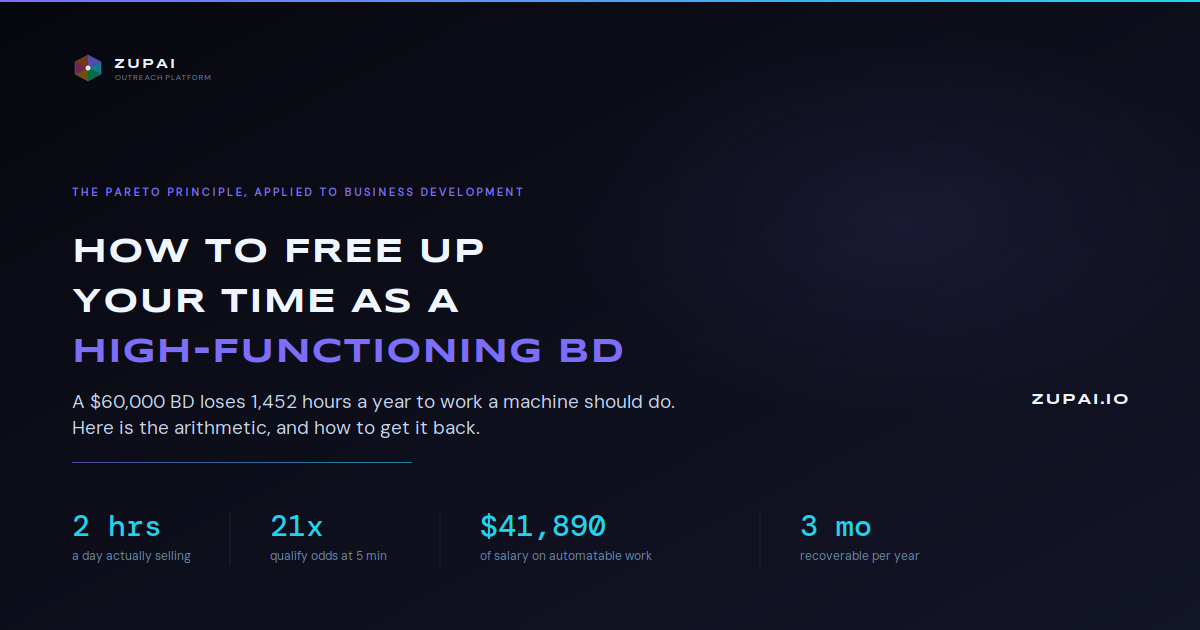
The Pareto Principle says 20 percent of your inputs create 80 percent of your outputs. In business development that is not a metaphor, it is a timesheet. The 20 percent is the live conversation, the objection handled well, the close. The 80 percent is finding names, checking for replies, remembering to follow up, and switching between five tabs. Automation does not make you a better BD. It removes the 80 percent so you can spend your day on the 20 percent you were actually hired for.
Where Does a BD's Day Actually Go?
A BD spends roughly 2 hours of an 8-hour day actively selling, and 5.5 hours on tasks that automation can eliminate or dramatically reduce. Administrative work alone consumes 41 percent of the day.
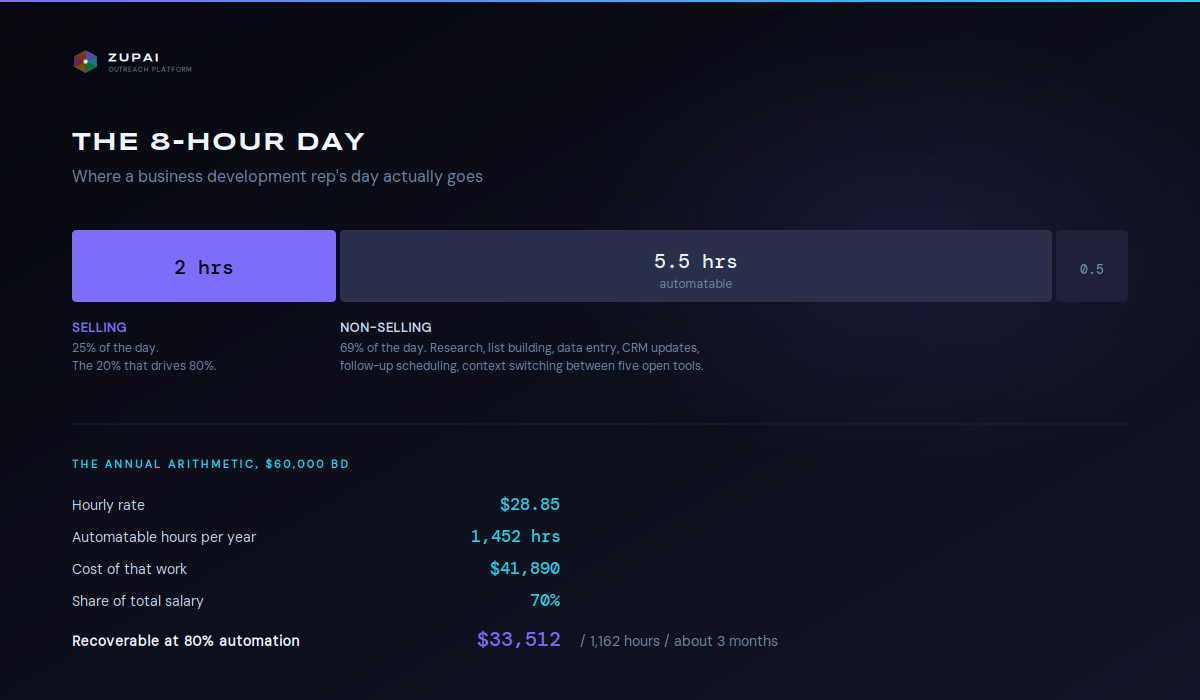
Salesforce's 2026 State of Sales puts non-selling work at 60 percent of total time. That figure is not padding. It is list building, research, data entry, CRM updates, follow-up scheduling, and the tax you pay every time you jump between tools.
That tax is measurable. Reps using five or more tools lose 30 to 40 percent of their day to context switching alone, before they have said a word to a prospect.
Every BD already knows this. Almost none of them can act on it, because the 80 percent is not optional. Someone has to build the list. Someone has to notice the reply. The work does not disappear because it is low-leverage. That is the actual problem automation solves: not doing your job, but doing the part of your job that is not your job.
What Does That Time Cost a $60,000 BD?
It costs $41,885 a year, which is 70 percent of the salary. A BD earning $60,000 works 2,080 hours a year at an effective rate of $28.85 an hour, and 1,452 of those hours go to automatable work.
| Metric | Value |
|---|---|
| Annual salary | $60,000 |
| Working hours per year | 2,080 |
| Effective hourly rate | $28.85 |
| Automatable hours per year | 1,452 |
| Cost of that work | $41,885 |
| Share of total salary | 70 percent |
You are paying $60,000 for a person and receiving roughly $18,000 of selling.
This is not theoretical accounting. For an SDR earning $60,000, approximately $22,200 goes to research time alone, which is 37 percent of their salary, before you count data entry or CRM hygiene. A Web3 BD Manager averages closer to $110,000. Run the same ratio and the number passes $75,000 a year, per head, on work that should never touch a human.
Why Is Manual Lead Generation the First Thing to Automate?
Lead generation is the largest time sink with the least judgment attached, which makes it the easiest to hand over and the fastest to pay back. It also decays faster than you can work it.
B2B data decays 25 to 30 percent every year, so the list you built last quarter is already rotting while you work it. And 51 percent of leads are never contacted at all, usually because the list outgrew the person maintaining it.
In crypto the decay is faster. A project that raised in January has a different treasury, a different team, and a different priority by April. By the time your spreadsheet is finished it is describing a company that no longer exists.
What good automation does here is specific:
- Pull continuously from live sources, not a one-off scrape. Zupai's pool holds 7,000+ Web3 projects from CoinGecko, DexScreener, ICODrops, DeFiLlama, CryptoRank, and CryptoJobs, updated continuously.
- Score and rank by signal, so a market maker sees low volume-to-market-cap ratios and a recruiter sees teams that just raised and are hiring.
- Assign to a seat automatically, with deduplication so no two reps work the same prospect.
If you are still copying names off DexScreener at 11pm, this is the first thing to kill. For the manual version of this step, including the exact signals worth filtering on before you reach out, see our Web3 BD playbook.
Why Do Missed Responses Kill More Deals Than Bad Pitches?
Because speed beats quality at the first touch. The odds of qualifying a lead are 21 times higher if you contact them within 5 minutes versus 30 minutes, according to an analysis of over 15,000 leads.
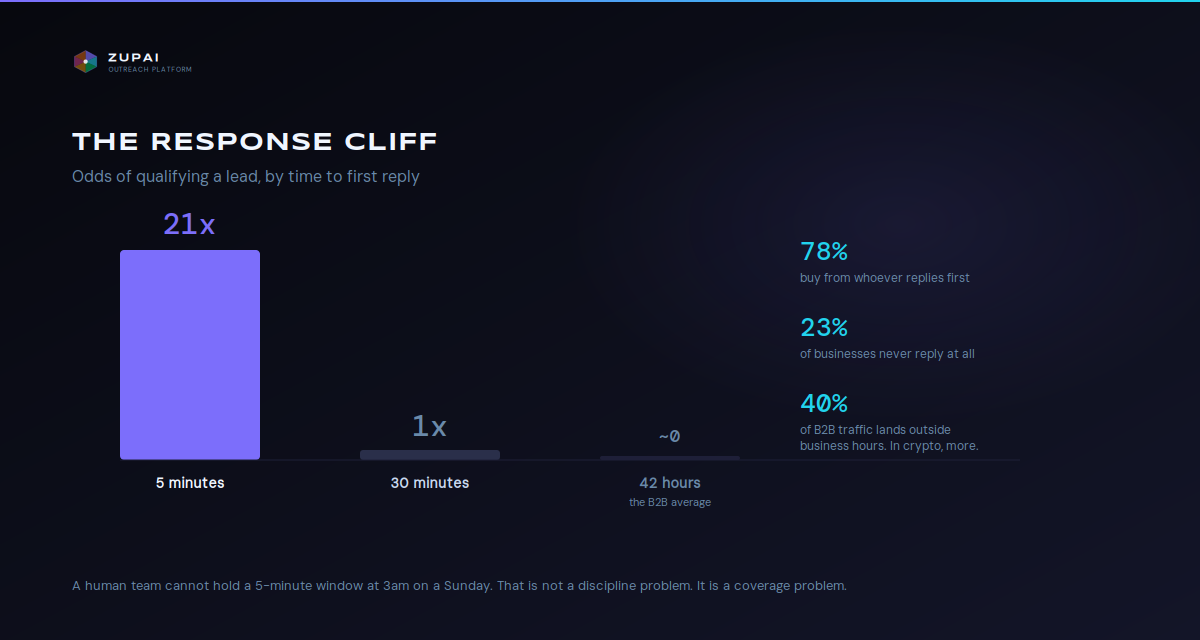
Not 21 percent higher. Twenty-one times.
Against that, here is what businesses actually do. The average business takes 42 hours to respond, and 23 percent never respond at all. Meanwhile 78 percent of customers buy from the company that responds first, and 35 to 50 percent of sales go to the first vendor to reply.
Now apply it to crypto. Some 40 percent of B2B traffic arrives outside standard business hours, and in a market that never closes, ours is far higher. A founder who just closed a round replies at their convenience, not yours. If you miss the first ten minutes, that conversation is gone, because you were never the only one in their inbox.
A human team cannot hold a 5-minute window at 3am on a Sunday. That is not a discipline problem, it is a coverage problem, and coverage is what machines are for. The fix is an auto-reply that reads the thread and answers in under a minute, at any hour, in any timezone, not a canned autoresponder every prospect detects instantly.
Speed carries one caveat worth naming. Replying around the clock is exactly the pattern that gets accounts flagged when the tool does not pace itself, so anything you trust with 24-hour coverage needs randomised timing and daily caps built in. We covered the safe limits in how to automate Telegram outreach without getting banned.
How Many Follow-Ups Do Deals Actually Need?
Five or more. Some 80 percent of sales require five or more follow-ups, and 44 percent of reps quit after one attempt.
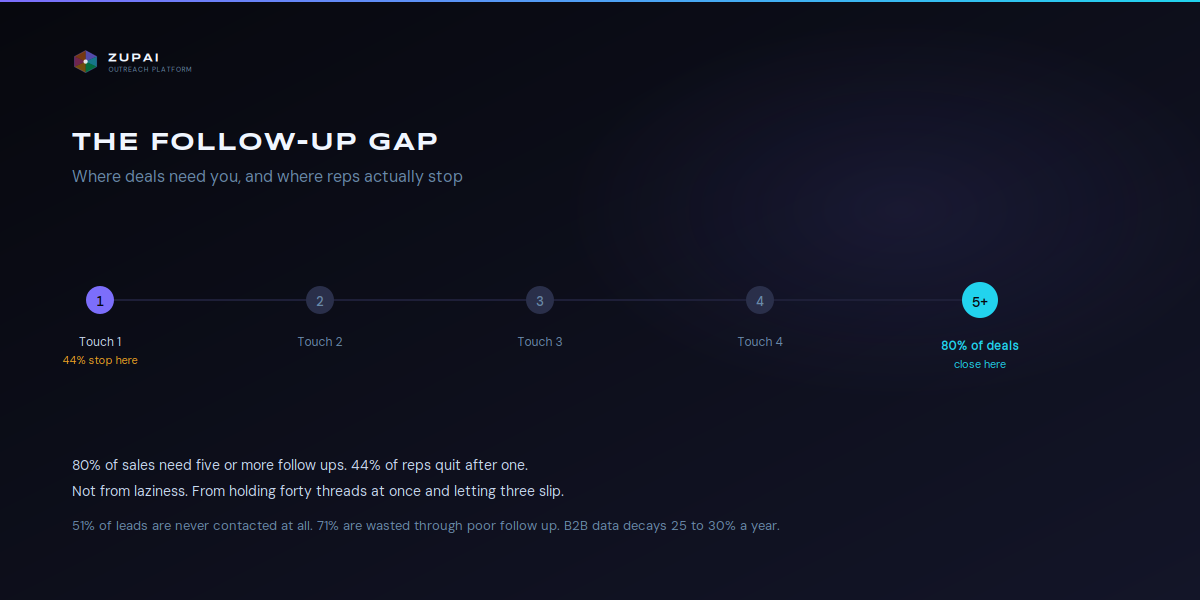
Read those two numbers together. Four out of five deals live past the point where nearly half your team stops. And 71 percent of leads are wasted through poor follow-up.
This is rarely laziness. It is arithmetic. A rep holding forty live threads will let three slip this week, and the three that slip look identical to the three that were never going to close. You cannot tell which is which, so the loss is invisible and nobody gets blamed for it.
The Day 2, 5, and 9 cadence works because each touch adds a new angle rather than asking "any thoughts?" But writing three thoughtful, context-aware follow-ups per lead by hand does not scale past a handful of prospects. Automation should fire the sequence, track every thread, and stop the moment a human is genuinely needed.
Unlike lead generation, this one does not save you time. It saves you revenue you already earned and then dropped.
Can AI Handle a Conversation Without Sounding Like a Bot?
Yes, but only if it tracks conversation stage rather than pattern-matching keywords. Most AI outreach tools generate the first message and stop, which automates the easy 10 percent and hands back the hard 90 percent.
Here is the failure mode. The prospect replies. Now a human has to read the thread, work out what stage the conversation is in, decide whether to qualify further or push for a call, and write something. The tool did the part you could have templated and left you the part that needed judgment.
This is the clearest dividing line between outreach platforms, and it is worth checking before you buy. We compared how the main Web3 tools handle it, including where we are weaker, in our honest comparison of AI outreach tools.
A conversation-aware layer does the opposite. It moves the thread through real stages, small talk, qualifying, handling objections, and setting the meeting, and it knows the difference between "sounds interesting" and "what does it cost," because those need different next moves.
When a proposal is warranted, it should build from your actual pitch deck, pricing sheet, and offer document, so what goes out carries your real numbers instead of a placeholder. It should use your own Calendly link, not the company default. Zupai's assistant reads the whole thread, tracks the stage, and generates proposals from your uploaded documents.
The honest limit: a machine should not close your deal. It should hand you a conversation that is already warm, already qualified, and already scheduled. The close is the 20 percent. Keep it.
Why Does Crypto Payment Support Matter for Web3 BD?
Because your buyer holds USDT, not a corporate Visa. If your billing stack demands a card, you have built a wall at the last step of a deal you already won.
This one is not about time, it is about friction. Every mainstream sales tool assumes a card, and that assumption is wrong for the entire market you serve. A Web3 project with a treasury and a multisig should not have to find someone's personal credit card to pay for your software.
Zupai bills in USDT and BTC directly, with no Stripe and no fiat friction, because a Web3-native platform that cannot take Web3 payment is a SaaS tool wearing the branding.
How Many Hours Can You Actually Get Back?
Between 624 and 1,162 hours a year, which is 3.6 to 6.7 months. The honest answer is a range, and where you land depends on how many of the five problems above you actually solve.
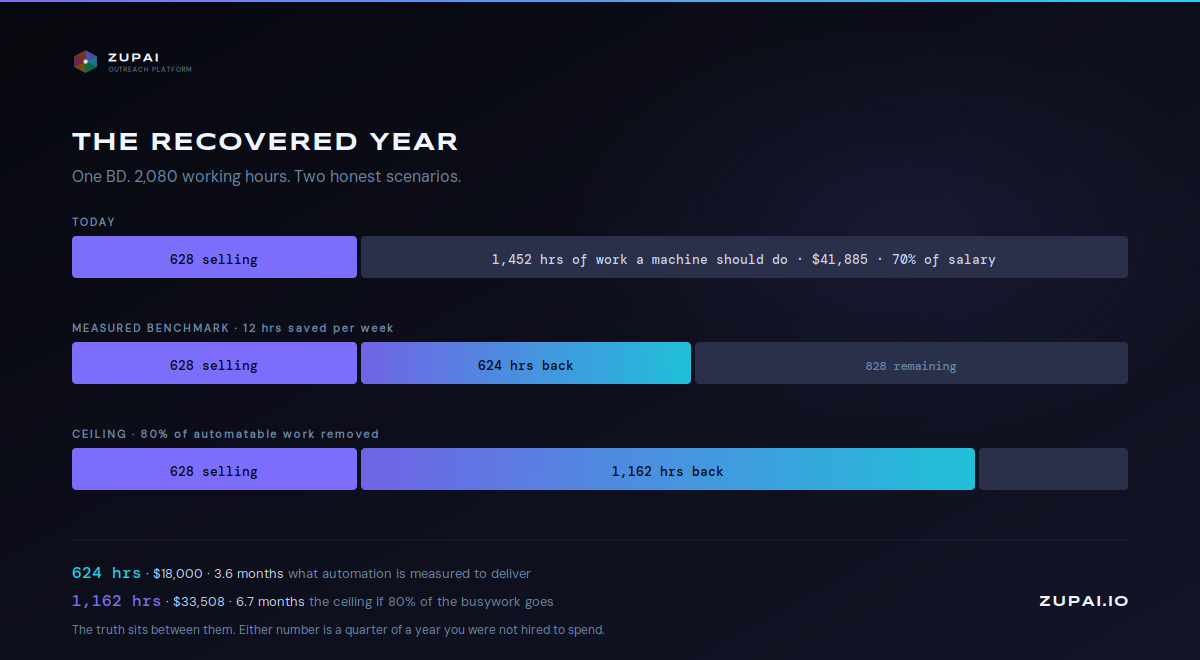
The measured benchmark. Sales teams using automation save 12 hours every week per rep, reclaiming nearly three months annually. For a $60,000 BD, that is 624 hours, $18,000, and 3.6 months back.
The ceiling. If you remove 80 percent of the 5.5 daily hours that are automatable in principle, you get 1,162 hours, $33,508, and 6.7 months.
The truth sits between them. But notice that even the conservative figure is more than a quarter of your working year. Across a ten-person team, the measured number alone is 30 months of BD capacity recovered annually. You are already paying for it. You are simply not receiving it.
What Should You Automate First?
Automate in this order, because each step funds the next:
- Lead generation. The biggest time sink, zero judgment required, easiest to hand over.
- First response. This costs you money, not hours. The 21 times window is the highest-value thing you are currently missing.
- Follow-ups. Most deals need five touches. Most reps give one.
- Proposals. Your deck and pricing already exist. You should be editing a draft, not writing from scratch.
- The tabs. Five tools open is 30 to 40 percent of your day gone before you speak to anyone.
Putting It Together
You were hired to have conversations that close. You spend six hours a day doing everything except that, and the arithmetic says it costs 70 percent of your salary.
None of the five fixes above make you better at selling. They give back the 3 to 6 months a year you were spending on work that never needed a human, so you can spend them on the work that does. That is the Pareto Principle applied honestly: not doing more, but removing the 80 percent that was never producing anything.
That is the workflow Zupai automates end to end. It finds and researches prospects, answers in under a minute at any hour, runs the Day 2, 5, and 9 follow-ups, and generates data-backed proposals from your real documents. For a full walkthrough of the pipeline, read our guide.
Your BDs should stop doing data entry at midnight and show up to conversations that are already warm.